High-performance custom glazing options certified under CCC, E-mark, and DOT frameworks.
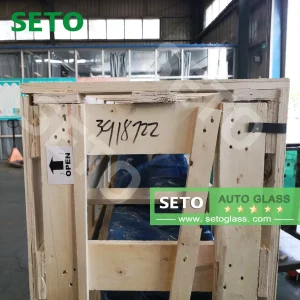
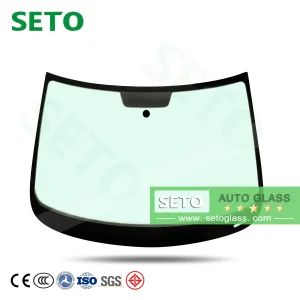
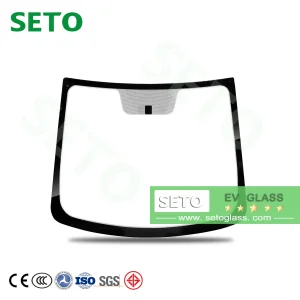
Shandong AGS Glass Co., Ltd. is a globally distinguished professional automotive glass manufacturer. We specialize in the integrated research, development, precision production, and global sales of advanced structural glass solutions. Our extensive product portfolio includes high-performance laminated safety glass, thermally optimized tempered glass, complete framed glass assemblies, bus panoramic glazing, tungsten heated defrosting glass, electric vehicle (EV) specific energy-saving glass, heavy-duty truck windshields, agricultural cabin windows, and robust engineering vehicles safety glass.
By constantly pushing the technological envelope of safety glass manufacturing, AGS Glass has transitioned from a local manufacturer into a world-class Tier-1/OEM and aftermarket glass systems partner. We maintain a relentless focus on material science breakthroughs, including thin-glass laminates for structural weight reduction and high-resolution HUD-compatible windscreens.
Spanning across high-capacity automation lines in Shandong, we configure tailored glass solutions to suit modern OEM vehicle assembly setups and structural glass replacements.
Empirical proof of our production capabilities, certification status, and worldwide export volume.
Engineered options across diverse transportation platforms. We design for optics, safety, and acoustic performance.
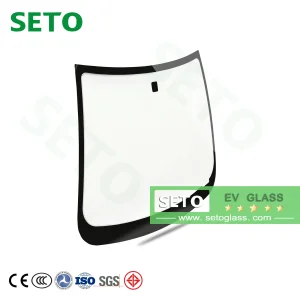
Laminated windscreens featuring PVB/SGP interlayers for extreme penetration resistance, optimized solar control, and integration with camera brackets for modern ADAS alignment.
Ultra-thin micro-tungsten wire arrays embedded within the laminated structure to enable efficient, uniform defrosting and de-icing without sacrificing optical clarity in sub-zero environments.
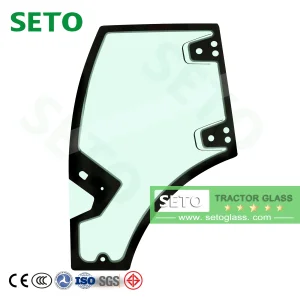
Heavy-duty tempered cabin glass panels developed for agricultural tractors, excavation shovels, and harbor cranes. Built to withstand high vibrational strain and dust abrasion.
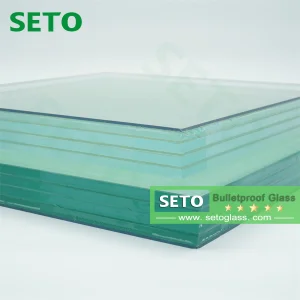
Multi-layered polycarbonate and float glass composites engineered to absorb high-velocity ballistic impacts. Essential for armored transport, security vans, and executive VIP sedans.
Engineered for electric vehicles to reduce solar heat gain (SHGC), cutting cabin cooling loads and preserving valuable EV battery range through metallic sputtered coatings.
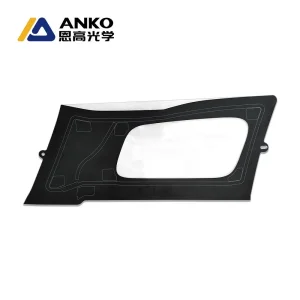
Integrated assembly structures featuring pre-installed PU gaskets and encapsulation borders, allowing direct modular installation on the vehicle assembly line (direct glazing).
Within the modern aerospace, automotive, and rail transportation landscape, glazing architectures have transitioned from protective wind barriers into structural components that provide enhanced structural rigidity, energy management, and sensory connectivity. Achieving compliance with these shifting standards requires transport glass solution manufacturers to possess robust design tools, advanced cleanroom autoclaves, and highly controlled bending kilns.
Laminated safety glass typically consists of two sheets of annealed glass bonded together under heat and pressure with one or more polymeric interlayers (primarily Polyvinyl Butyral - PVB). If impacted, the glass fragments adhere to the interlayer, preventing dangerous shards from entering the passenger cabin and maintaining forward visibility. This architecture is mandatory for front windscreens globally due to its energy-dissipating performance during collisions.
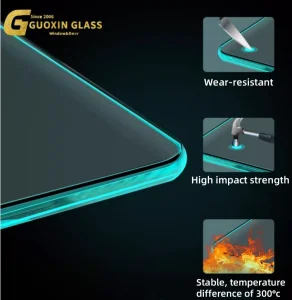
Tempered glass, by contrast, undergoes rapid thermal tempering to induce a state of high compressive stress on the surface balanced by tensile stress in the center. This treatment increases mechanical strength up to fivefold compared to standard float glass. When fractured, it disintegrates into small, blunt particles. Modern vehicles frequently utilize laminated glass in side and rear windows for added vehicle security and acoustic dampening, while tempered glass remains standard for single-pane sunroofs and rear backlites due to its lighter weight and lower cost structure.
For transit systems operating in alpine environments (commercial coaches, heavy logistics haulers, rail engines, and airport support vehicles), active defrosting is a critical safety requirement. AGS Glass designs and manufactures advanced tungsten heated safety glass. This technology embeds micro-fine, wave-shaped tungsten wires (ranging from 10 to 20 micrometers in diameter) into the PVB interlayer. These wires are virtually invisible to the driver under normal operating conditions, preventing glare and optical distortion.
By applying a low-voltage DC power supply (typically 12V, 24V, or up to 48V for modern EV platforms), the resistive load generates uniform heat across the glass surface. This system melts snow and ice and eliminates interior fogging within minutes, far faster than traditional hot-air blower configurations. The thermal performance is carefully balanced with advanced IR-reflective sputtered coatings to ensure the vehicle retains optimal thermal efficiency during hot summer periods.
The rise of autonomous vehicle architectures requires high-precision optical zones within the front windscreen. Advanced Driver Assistance Systems (ADAS) depend on cameras, LiDAR, and radar modules positioned behind the upper section of the windshield. Any optical distortion, thickness deviation, or wedge angle variation in the glass will compromise these sensors' spatial calibration. AGS Glass utilizes automated optical scanners to measure distortion down to millidiopters, ensuring error-free sensor operation.
Additionally, Head-Up Display (HUD) systems project critical telemetry directly onto the windshield. This requires the PVB interlayer to be manufactured with a precise wedge-shaped cross-section. Without this wedge-shaped profile, the projection reflections from the inner and outer glass surfaces generate a double-image effect, commonly known as ghosting. Integrating HUD technology requires high thermal control during the laminating stage, which represents a key technical division between standard factories and Tier-1 transport glass manufacturers.
How AGS Glass leverages high automation and advanced process engineering to optimize global distribution.
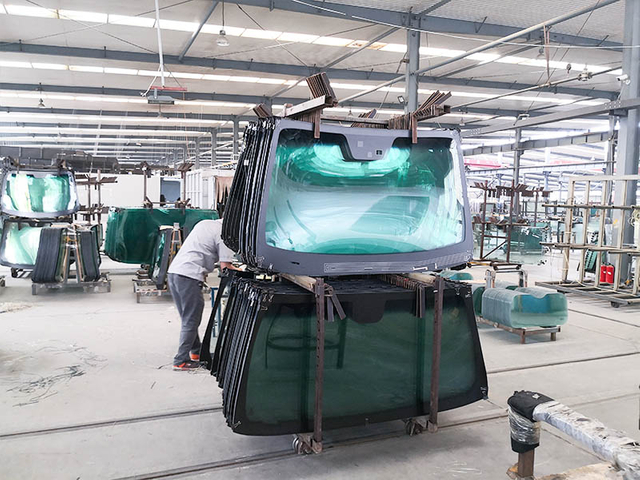
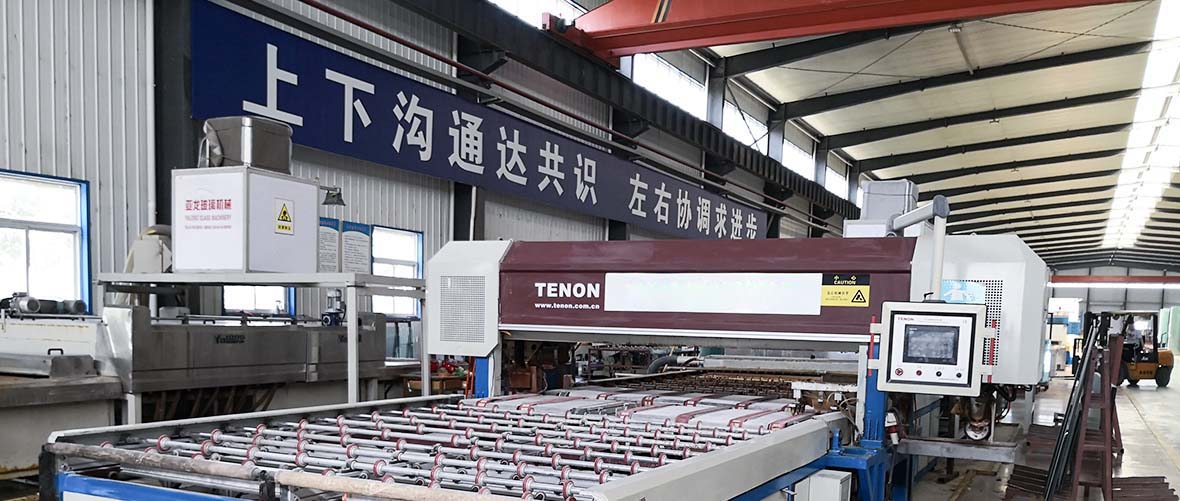
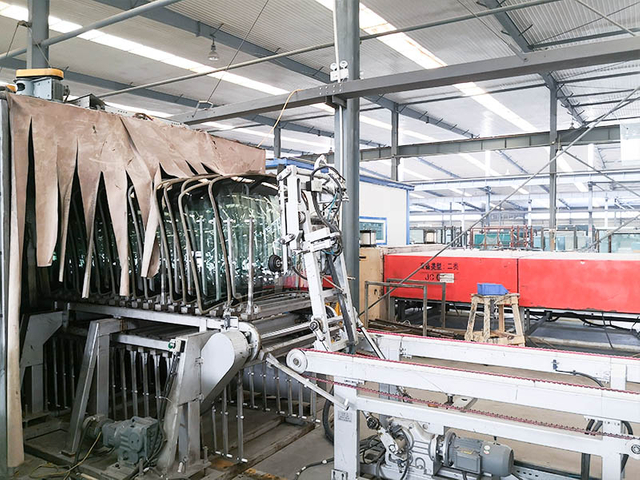
The manufacturing capabilities at the Shandong AGS Glass production facility are structured on Industry 4.0 principles, ensuring high repeat accuracy and minimal human error. Our production lines feature automated glass loading systems, CNC glass cutting tables, robotic edge-grinding cells, and automated screen printing systems for black frit application.
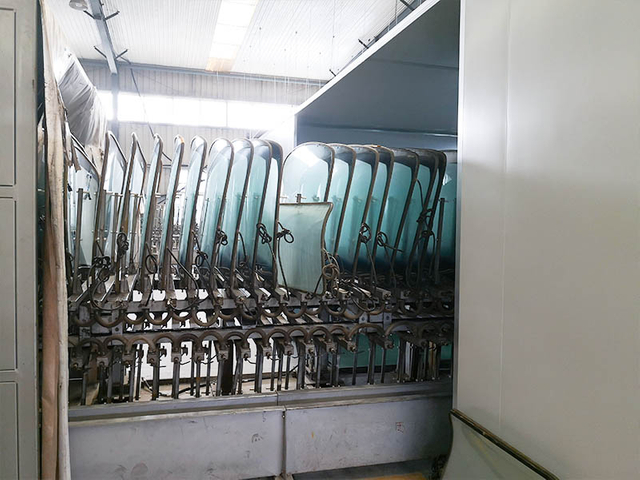
By managing our core tempering and laminating lines in-house, we eliminate the supply bottlenecks common to smaller processing shops. With over 12 senior and intermediate glazing technicians overseeing our production runs, we maintain real-time process monitoring over kiln temperatures and bending profiles. Our advanced convection bending kilns allow for complex double-curvature shapes, which are increasingly demanded by modern aerodynamic bus and automotive designs.
This automated capacity is backed by a robust supply chain network. Located in Shandong, China, we have direct access to high-quality raw float glass materials from the country's primary manufacturers, and we benefit from streamlined shipping links through major regional deep-water ports. This strategic location enables us to export our products efficiently, ensuring shorter lead times for our B2B customers globally.
Our high-pressure autoclaves precisely regulate pressure and temperature profiles, removing air bubbles and ensuring a uniform bond between the glass sheets and the PVB interlayer.
Automated diamond grinding wheels polish and contour the glass edges to exact tolerances, reducing stress concentrations and preventing micro-fractures during transport and installation.
Our production process integrates continuous quality checks, utilizing digital projection technology to verify optical path values and check for deviations from geometry models.
AGS Glass meets and exceeds international safety regulations, facilitating global logistics operations.
Passed and maintained since 2015, these represent the highest tier of quality management systems designed specifically for the international automotive supply chain.
Fully approved under the Department of Transportation (DOT) framework, permitting our automotive windshields for unrestricted use across North American highways.
Tested to ECE R43 requirements (E-mark approval) and China CCC standards. This compliance ensures seamless homologation and customs clearance globally.
Purchasing glass solutions at an enterprise level requires evaluating manufacturing limits, quality control protocols, and supply chains. This checklist provides global sourcing teams with key benchmarks for evaluating prospective Tier-1 glass partners:
AGS Glass supports procurement teams by offering clear documentation, DDP delivery configurations, customized labeling, and testing certificates for each batch. This support reduces compliance headaches and lead-time delays at target customs hubs.
Technical answers regarding glass formulation, laminating tolerances, and ordering logistics.
SentryGlas Plus (SGP) ionoplast interlayers are approximately 100 times stiffer and 5 times tougher than conventional PVB interlayers. SGP allows the laminated glass to retain its load-bearing capacity even after both glass sheets have fractured, keeping the unit intact in its frame. This makes SGP ideal for armored security transport, high-speed rail, and cyclone-rated heavy equipment cabs.
We use precision-controlled sag-bending and press-bending furnaces. Gravity sag bending slowly heats pair-matched glass panes on custom-designed steel molds, allowing the glass to conform to its design shape without mechanical stretching. This preserves the surface quality and eliminates refractive errors, ensuring the windshield remains optical distortion-free, even for HUD and ADAS camera views.
Yes, we offer complete modular transport glass solutions. This includes pre-applied polyurethane (PU) adhesives, edge molding, locating pins, metal hinges, and integrated weather-stripping. Sourcing pre-assembled modular glass units allows vehicle manufacturers to reduce assembly line cycle times and improve structural sealing.
Our company is fully certified under ISO/TS-16949 and ISO-9001 quality management standards. In terms of product compliance, our glass displays China CCC marks, European Union E-mark approvals (ECE R43), and United States Department of Transportation DOT certifications, ensuring it meets safety standards globally.
Tungsten heated glass operates via direct electric resistance heating inside the laminate, requiring no hot air warm-up cycle. This melts snow and clears condensation rapidly, even in severe cold. It runs silently, cuts HVAC power consumption, and provides uniform defrosting across the entire windshield surface.
Explore our full line of automotive windshields, safety doors, special machinery glass, and vehicle solutions.

 AGS Glass